Oolong Tea Guide: What Makes It So Interesting
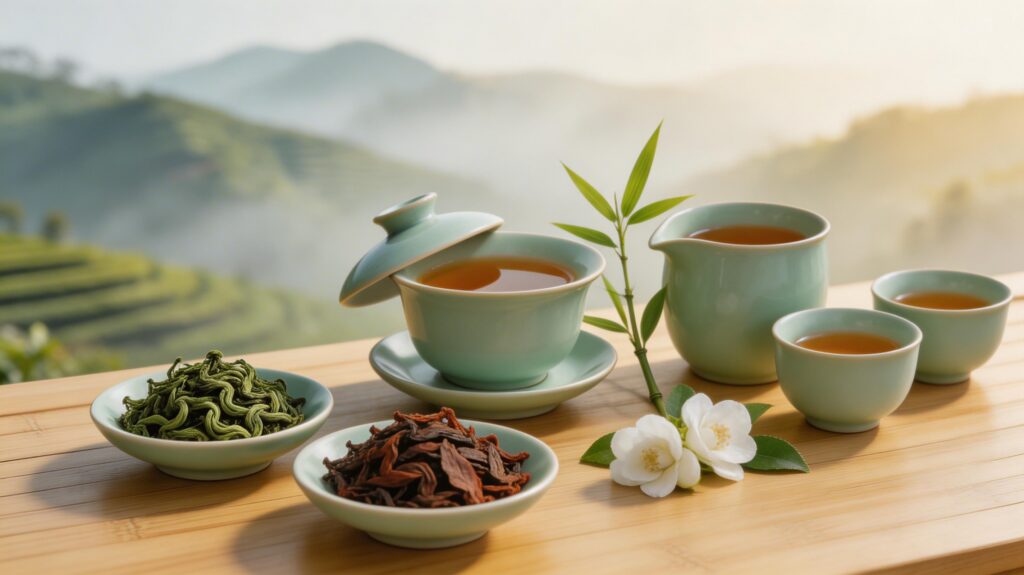
The first time I smelled a good Tieguanyin, it reminded me of orchids after rain, with a little creaminess underneath. Then I tasted Da Hong Pao a few days later, and it was like roasted nuts, dark fruit, and a mineral edge all showing up at once. That contrast is why I keep coming back to oolong.
This oolong tea guide is for the person who has tried green tea and black tea, liked both in different ways, and wondered what sits between them. Oolong is that middle ground, but I think that description still undersells it. Some oolongs taste bright and floral. Others are heavy, roasted, and almost cozy. A few do both in the same cup.
What Oolong Tea Actually Is
Oolong is a partially oxidized tea. That sounds technical, but in practice it means the leaves are allowed to change a little after picking, then that process is stopped at a chosen point. Green tea barely oxidizes. Black tea goes much farther. Oolong lives somewhere in between, though that “somewhere” stretches a lot more than people expect.
In my experience, oxidation is only part of the story. Rolling, resting, roasting, and the skill of the tea maker all matter a lot. Two oolongs can be made from similar leaves and still taste worlds apart. One may be light and orchid-like. Another may taste like toasted barley and dried plum.
Styles You’ll See in an Oolong Tea Guide
If you only remember one thing from this oolong tea guide, remember that oolong is not one flavor. It is a category with real range.
Tieguanyin, the Floral One
Tieguanyin, also written Tie Guan Yin, is one of the most famous Chinese oolongs. Traditional versions can be lightly roasted, while modern styles often lean greener and more floral. A good one smells like lilac, gardenia, or orchids. The liquor can be silky and sweet, with a clean finish that feels almost cool.
I usually brew greener Tieguanyin at 90°C for 20 to 30 seconds in a gongfu setup. Western style works too, around 2 to 3 minutes at the same temperature. If you overbrew it, the sweetness can turn sharp pretty fast.
Da Hong Pao, the Roasted One
Da Hong Pao comes from Wuyi, and the better versions have a deep roasted character with mineral notes. People talk about “rock rhyme,” and while that phrase gets tossed around a lot, I do think good Wuyi oolong has a kind of dry, stony finish that stays in your mouth after the sip. It can taste like roasted chestnut, cocoa husk, and baked stone fruit.
For this style, I like water at 95°C to 100°C. Short steeps work best, maybe 15 to 25 seconds at first. The leaves can handle many infusions. Some fine Da Hong Pao keeps giving for ten rounds or more, though the later cups get softer and sweeter.
Milk Oolong and the Trap of Flavor Naming
Milk oolong gets talked about a lot because the name sounds almost too good to be true. Real milk oolong usually refers to a style of tea with naturally creamy, buttery notes, not actual milk added in. That said, there are flavored versions on the market too, and the label can be messy.
I think this is where buyers need to be careful. A naturally creamy Jin Xuan oolong can taste like fresh cream, sweet corn, and warm bread. A flavored version may lean perfume-heavy. One is subtle and pleasant. The other can feel a little fake if you are sensitive to aroma.
How Oolong Tastes Across the Oxidation Range
The easiest way to understand oolong is to think of it as a spectrum.
- Lightly oxidized oolongs: floral, grassy, creamy, sometimes fruit-like
- Medium oxidized oolongs: honeyed, toasted, peachy, with more body
- Heavily oxidized or roasted oolongs: cocoa, nuts, dried fruit, spice, mineral notes
That list is simple, but real cups are messier. A lightly oxidized oolong can still feel thick if the leaves are high quality. A roasted one can still smell of flowers before the first sip. I like that unpredictability. It keeps the category from getting boring.
How to Brew Oolong Tea Without Fuss
This oolong tea guide would not be very useful without brewing tips, so here is the version I actually use at home.
For gongfu brewing, start with 5 to 7 grams of leaf in a small gaiwan or pot. Use 95°C water for most oolongs, though greener styles often do better at 85°C to 90°C. Give the leaves a quick rinse if you want, especially for tightly rolled teas. Then steep for 15 to 30 seconds and adjust from there.
For a western mug, use about 2 grams per 100 ml of water. Steep 2 to 4 minutes. The downside is that you miss some of the tea’s changing layers, but it is still a good way to drink oolong without treating it like a ceremony.
If the tea tastes flat, use more leaf before you blame the tea. That is usually the fix. Oolong often wants a little more leaf than beginners expect, and it usually rewards it.
What to Buy First
If you are new, I would not start with the rarest or most expensive tea. Buy two very different styles and compare them side by side. A greener Tieguanyin and a roasted Wuyi-style oolong make a great pair. One teaches you floral clarity. The other shows you depth and warmth.
Price matters here. A decent beginner Tieguanyin may cost around $12 to $25 for 50 grams. A better Da Hong Pao can run higher, sometimes $20 to $50 for 50 grams, and truly serious versions climb past that quickly. Cheap oolong exists, but the low end can taste sugary in a strange way or flat after one steep.
If you want a shortcut, ask the Hou Tea AI Tea Doctor for a personalized pick. I think that is especially useful if you know you like floral tea or roasted tea but are not sure where to start.
Why Oolong Keeps People Hooked
What keeps me interested is that oolong changes from steep to steep. The first cup can be bright and perfumed. The third may feel rounder and sweeter. By the fifth, the roasted notes or mineral notes often start to show more clearly. That shifting character makes a good session feel alive.
And honestly, some days I want Tieguanyin. Other days I want a heavy Wuyi tea that tastes like a wood-fired kitchen after dinner. Oolong lets me choose without changing tea families.
If you are building your own oolong tea guide at home, start with one floral tea and one roasted tea. Brew them carefully, compare them, and notice what lingers after the swallow. For me, it is often the finish, a faint orchid note or a memory of toasted chestnut, that tells me the tea was worth the trouble.